Photo: Parks Canada
In each GJAC Member Profile, we’ll pull back the curtain on recent work and accomplishments by our members, including deep dives into the process behind the scenes and the inspiration behind the work. In this edition, we hear from Curtis Gillespie about the spark and the process that led to his first-place, award-winning entry, “Smoked” from the 2026 GJAC Media Awards in the Features category.
Q: Congratulations on your first-place win in the Features category for “Smoked,” that was published in Golf Digest. This line really resonated, “In a way, golf is an exercise in choosing what to see.” In that simple sentence, you capture what golf means to so many GJAC members. More than what we shot, it’s about the experience of enjoying nature and the company of others. Speak a bit about what initially drew you to the game and eventually writing about it?
A: What initially drew me to the game was playing with my dad and my brothers growing up in Calgary. We didn’t have a lot of money and so we used to play this nine hole course in Northwest Calgary called Confederation. Even though it was a basic public nine holer, it was still incredibly fun to play. It was hilly, and it had lots of movement in the terrain. And, it always made me think of the foothills, the trees, and different types of grasses. I can still remember every hole of that golf course even though I probably haven’t played it in 40 years.
After that, as a junior in Calgary, I played at the Elks club, which was also a really pretty golf course with lots of mature trees; it was always a treat to play. I went to university in Scotland and played on the golf team at the University of St Andrews. That was where I really learned about the game of golf in depth. That was, without question, where I started to think about the game of golf as something more than just hitting the ball and walking around a nice landscape! The history of the place was overwhelming and romantic and I knew then that someday I would have to try to find a way to write something about golf.
Q: What drew you to write this story about Jasper and the wildfires of 2024?
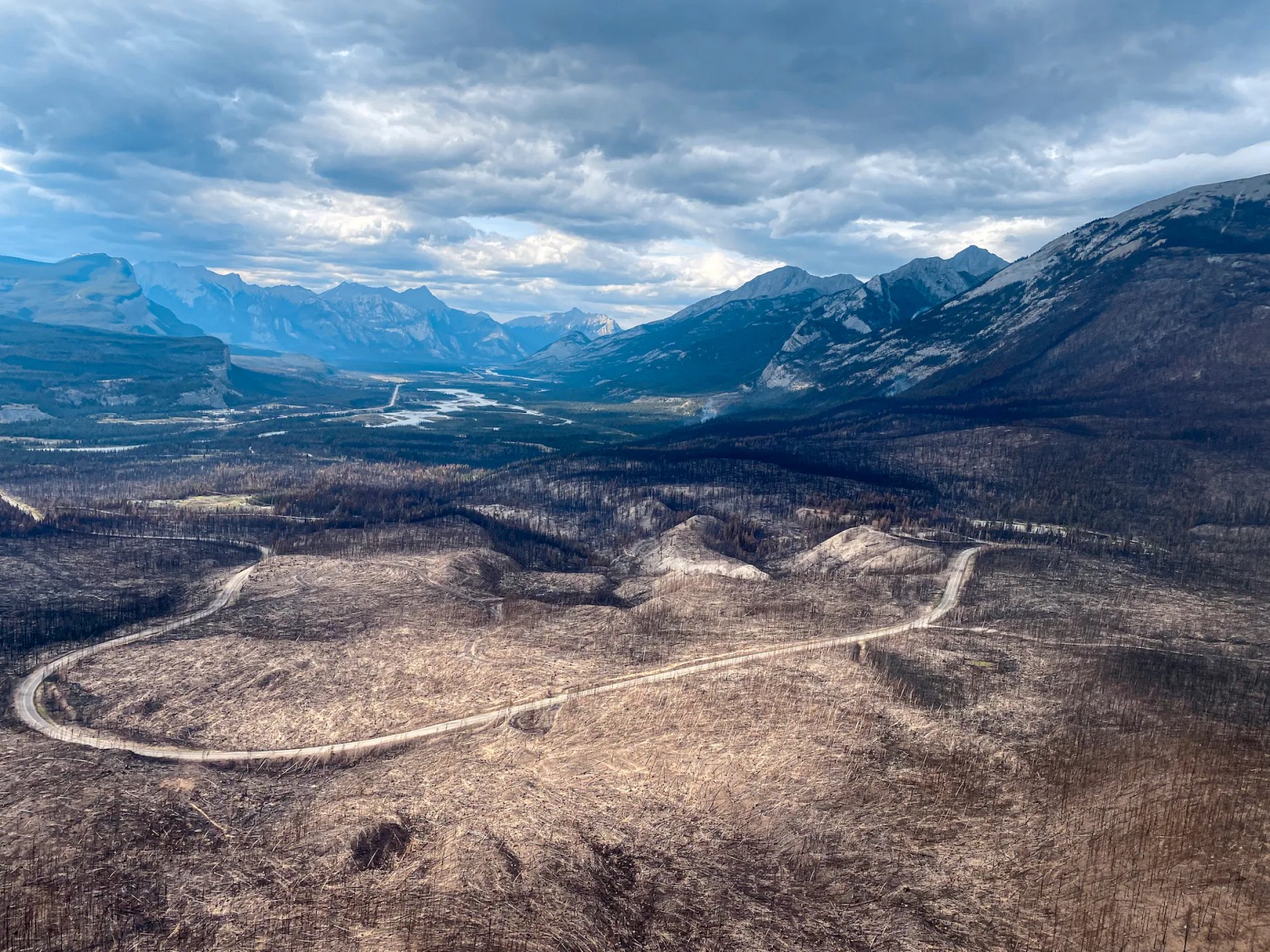
A: I was first drawn to the story by the simple fact that I have been playing the Jasper course for probably the last 40 years. It has always been a magical place for me. I had played there with friends and family, and it also became a very special place to play golf with my wife’s family. Living in Edmonton meant that we were always fairly close to Jasper. And of course, the more you learn about the game of golf and the architecture of the game, the more you come to realize that Jasper is not just a golf course, it’s a work of art. On top of that, my wife and her sister were hiking in Jasper when the fires hit. They had to evacuate along with the rest of the town. It was a harrowing experience for everybody involved, obviously. And so after the fires I was in touch with Tahlon Sweenie, the Director of golf at Jasper (now at Cabot Revelstoke), and we talked about me coming out there to write a story about what had happened. That was the spark.
Q: Walk us through your research and reporting process for this piece.
A: The research and reporting process was fairly simple, to be honest. I arranged times to go up to Jasper to play the course once it had been cleared for play. And I organized interviews with Tahlon and others. My research process tends to be a little more fluid and intuitive, in that I believe engaging in conversation with people is really what’s most important. I rarely go into an interview with a set question list. Not rushing, and taking the time to make sure that people are comfortable talking about the issue at hand, especially if it’s been a traumatic experience. Which, in this case it obviously was.
Q: What was the most difficult part of putting this story together?
A: Oddly, enough, for a story about such a difficult subject, it was not overly difficult to write. Of course I don’t mean it was easy to write! What I mean is that the story that needed to be told seemed to be laid out pretty clearly in front of me when I set out to write the piece after completing my reporting. There were obstacles, of course, but most of those obstacles were internal, in that it was really about making sure I found a balance between the human story, the golf course story, and the environmental story. It was complex, yes, but complex in a way that was rewarding in that I wanted to properly reflect and honour what people had been through in Jasper and how they responded, while also making clear that we have environmental challenges ahead of us, not just with golf, but with the planet.
Q: Is there a line, quote, or moment in the piece you are proudest of? Is so, why?
A: That’s a tough question! I wouldn’t say that there’s a line, quote, or moment that I’m particularly proud of in the piece, mostly because I don’t really think that way about stories that I write. To me it’s more whether they cohere at a global level. I suppose, if pressed, I would say that I think the story managed to tell both a specific story of how one golf course responded to a natural disaster while also telling a story of how our planet is changing.
Q: How did this project push you outside your usual beat or style?
A: I’ve done a lot of golf writing in my day, as well as many other styles of writing, such as political, travel, cultural, and science writing. This project definitely felt in my so-called wheelhouse!
Q: Talk about the pitching process and landing the piece with Golf Digest?
A: The pitching process was interesting because I had already made contact with the editor at Golf Digest (through my friend David McPherson) about another story that I had pitched him that he was interested in. I then pitched a story about the Jasper fires to a different magazine here in Canada, and they said no. So I thought to myself, gee, ‘Why not see what Golf Digest has to say.’ And luckily they were interested! I suppose this would be something of a lesson for younger or emerging journalists, which is that when an outlet says no, they are not saying no to the story, they are saying no to the story for them. That doesn’t mean it’s not a good idea and that it won’t be a good story. It just means you might have to try somewhere else. I bet that’s happened to me 20 times in my career, where I’ve pitched a story somewhere, they have decided that it’s not for them and then I have sent the idea somewhere else and it works for a different outlet. If you think you have a good idea, don’t give up on it the first time someone says no.
Q: What feedback, perhaps from readers, editors, judges, and/or peers, has stuck with you from those that read this feature?
A: The feedback to the story was positive. I got more work from Golf Digest out of it, so that was a good thing! Overall, I would have to say that the feedback I got on the story reflected what I hoped the story would achieve, in that people had a good understanding after reading the story of what specifically happened at Jasper, how the team at Jasper responded, and the bigger picture story of the environmental challenges we face today and which are only going to get tougher to deal with in the years to come.
Q: What advice would you give someone in a similar position chasing a similar story or creating a similar piece?
A: Every story is unique, so I’m not sure that I have any specific advice to someone chasing a similar story, especially a story like this, which was in many ways a one off. Having said that, I think I would reinforce what I alluded to above, in that if you think you have a really great story to tell, don’t give up on it. Keep trying. Keep pushing. Keep looking for the right outlet. Don’t make any enemies! If you keep at it, you are likely to eventually succeed. Maybe it won’t even be with the story you’re chasing in the moment. But maybe your persistence combined with your amiability will convince editors to give you a future assignment. 🙂
Q: What’s next for you? What are you currently working on or writing about?
A: I’m currently working on a couple of stories that are not golf related, but rather have to do with politics. We live in very complicated times. How’s that for an understatement! And so there is no shortage of political topics out there. As for golf stories, I’m not really working on anything specific at the moment, but I do have a few irons in the fire, long irons, ha ha. I’m also in the very early stages of a book that has a golf theme in it, though I wouldn’t exactly describe it as a golf book. Give me a couple of years and then maybe I’ll talk more about it!