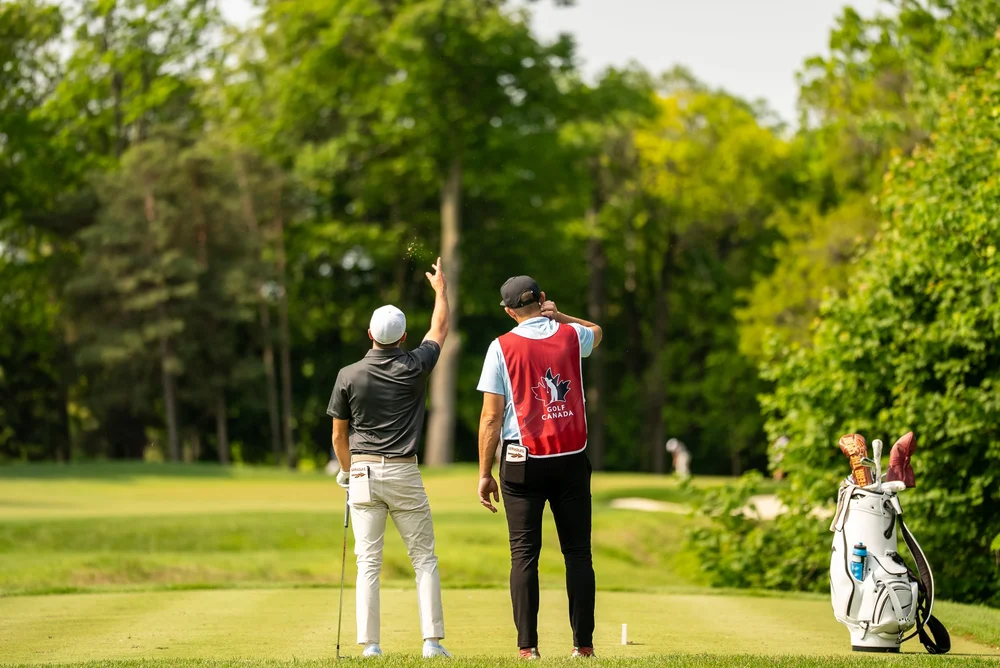
In each GJAC Member Profile, we’ll pull back the curtain on recent work and accomplishments by our members, including deep dives into the process behind the scenes and the inspiration behind the work. In this edition, hear from Alex McKenzie about his photo titled ‘Final Adjustments,’ the first place winner of this year’s Golf Journalists Association of Canada Award in the Photo (Action) category.
Q: Congratulations on your award. Can you describe the shot and the project it was associated with?
A: The photo was from the U.S. Open qualifier held at Lambton (Golf and Country Club), and that was obviously a cool project to be a part of – I shot both photography and video for the club. That qualifier had one of the highest numbers of available slots of almost any U.S. Open qualifier, so it was a very competitive field. You had up-and-comers like Luke Clanton, plus Keith Mitchell and Camilo Villegas, who isn’t as big now but was huge when I was growing up. Being on the grounds for a day like that, with guys I later saw playing the RBC Canadian Open on the weekend at TPC Toronto was pretty wild. That particular photo is on 17 at Lambton, on a breezy day. They checked the wind and went through their numbers for what seemed like an exorbitant amount of time, and I think in the end it was too much, because Luke tried to hit a hold-off fade that ended up being too much of a fade, and he put it down the right side, which, if you’ve played 17 at Lambton, is an absolute no. My guess is they were in between clubs, he went with the bigger one to hit more of a hold-off, and it didn’t pan out. So that photo is really just them making that choice, and Luke throwing some grass in the air.
Q: You titled the photo ‘Final Adjustments,’ which says a lot about the story the photo tells – it’s a lot more than just a photo of a golfer swinging a club. Why do you think this shot makes for an interesting storytelling piece, rather than just a nice shot of someone swinging a club?
A: I think it’s both of them together. A lot of it depends on the relationship between caddie and player – I know these two have been together a while, and sometimes the caddie is the one doing a lot of this. He’d checked his numbers and the wind, but Luke felt the need to check it himself too. Neither of them has a club in hand – they’ve got the yardage book out, really trying to figure out what the wind is doing on a long iron into that green. It’s not an easy shot in, so there’s a lot of thought that goes into it. There’s obviously a story in someone hitting a golf shot, but that’s the final piece. There’s a lot of thought beforehand that I think most people underestimate, especially in professional golf – most of the time you’re not just pulling out a rangefinder with slope on it, picking a number, deciding the wind’s left-to-right, and hitting a 6-iron. There’s a lot that goes into it, especially over 36 holes of competitive golf, that not many people see.
Q: Do you remember what gear you were shooting with that day, and how far you were from the action? How do you set up for a shot like that, knowing you want them in the foreground and the hole in the background?
A: That day I was shooting both photo and video. On the photo side, I had a Sony A7 body with a Sigma 70–200 lens. I was probably fairly close to the long end, maybe around 175mm rather than all the way at 200 – it’s a relatively longer hole, and the compression at that focal length brings the hole in a bit tighter around them so you can see the decisions they’re making. There were other options – I could have gone tighter on just Luke, just on the grass being thrown, even just the hand in the grass. But this framing worked well, with the bag perfectly in frame and both of them centered, so I kept it there. For about 98% of the time I’m shooting golf, it’s just the 70–200; I’ll go wider on the rare occasion I need to. For this shot, I’d have to pull up the exact numbers, but I would have been around f/2.8, since the two of them and the bag were all roughly the same distance from me – so I didn’t need to worry about one being a foot or two in front of the other and going out of focus. f/2.8 worked fine because they’re both sharp, and I didn’t need the background in focus either. ISO would have been around 250 – I generally keep ISO as low as I can and push the shutter speed as high as possible, especially for action like this.
Q: The photo is a still frame, but it tells a story about the pressure, the 36-hole day, the relentlessness of a tournament like that. When you’re out shooting a tournament or a course, how do you look for images that tell that kind of story, instead of just a nice shot of a hole or someone with a club?
A: I think it depends a lot on the assignment and who the client is. If I’m there for Golf Canada, say, the brief might lean more toward capturing a specific logo or player. With Lambton as the client, the course, the story matters more than which specific player is in the shot, so I have more flexibility to actually tell a story rather than shoot close-ups of people. Part of my job is photographing the course and making it look as good as possible, and sometimes that means no people in the frame at all. For tournament golf, there’s a lot of moving around and figuring out where things are, but sometimes it’s about having played the game yourself, knowing the struggles, and being able to see how something’s going to unfold before it happens. Having an idea of the shot you want, or even seeing it before you put the camera to your eye, lets you get into position ahead of time. Like, I know a player’s hitting a wedge from a certain spot, and if the angle here isn’t interesting but I can run twenty meters left, I know I can get the frame I want.
Q: What is your workflow like when it comes to figuring out what your shotlist will look like? Do you have an idea of what shots you’re looking for in advance, or do you wait to see what looks good once you start shooting?
A: My typical workflow is, I always get there ahead of time. Ideally, I already have a rough understanding of the course before I arrive. There’s a great app called Sun Seeker, and I go around the entire course and figure out where the sun will be at different times, making detailed notes for every hole on when the green is going to lose sun, since that’s my priority for course photography: making sure the green has light. You can be deliberate about it, but if you show up at a hole and it doesn’t have sun, you’ll be kicking yourself. So I’ll go around all eighteen holes, note the timing for each, and in doing that I’ll already start to see certain angles, whether handheld or drone. Handheld shots require more deliberateness because you physically have to be there, so depending on the time I have on site, I’ll note which holes are best handled by hand, so I make sure I’m physically there at the right time. For holes that don’t need that, I can cover two or three at once with the drone. If it’s pure course photography, I care more about getting to specific frames I’ve already scouted, though I’ll still sometimes see something new when I’m actually out there. For a video shoot, though, I have to be much more specific, because we’ll have models or golfers and I need to take them to exact spots for exact shots – that requires an actual shot list.
Sometimes you get to go to courses that make it a lot easier to get a really good photo – Toronto Golf Club is one of those, TPC Toronto too. There are places where you show up and it’s basically, ‘just stand here at the right time.’
Q: With drone photography becoming much more popular these days, how do you go about balancing what you capture from the air versus on the ground?
A: I made an Instagram post the other day saying I strongly believe you don’t play golf from that height, and I’m not saying you can’t get beautiful shots from a drone. But at the same time, from that height you lose the eyebrows on the bunkers and lose depth perception the higher you go. So actually walking the course, you’ll always find angles you hadn’t pre-planned. It comes down to having the eye – knowing how to frame a shot, what needs to be in it, what shouldn’t be, what height it should be at.
Q: Can you share more about any upcoming projects that you’ll be working on?
A: I don’t really know if this one will end up as a photo project, but I’m heading to Ohio, New York, and Michigan soon. I’m going back to Forest Dunes, which is exciting – that one’s more about their new course, and it’ll be a lot of interviews, so that one’s less about photography. That’s probably the most exciting one coming up, along with a course in Ohio and New York.